


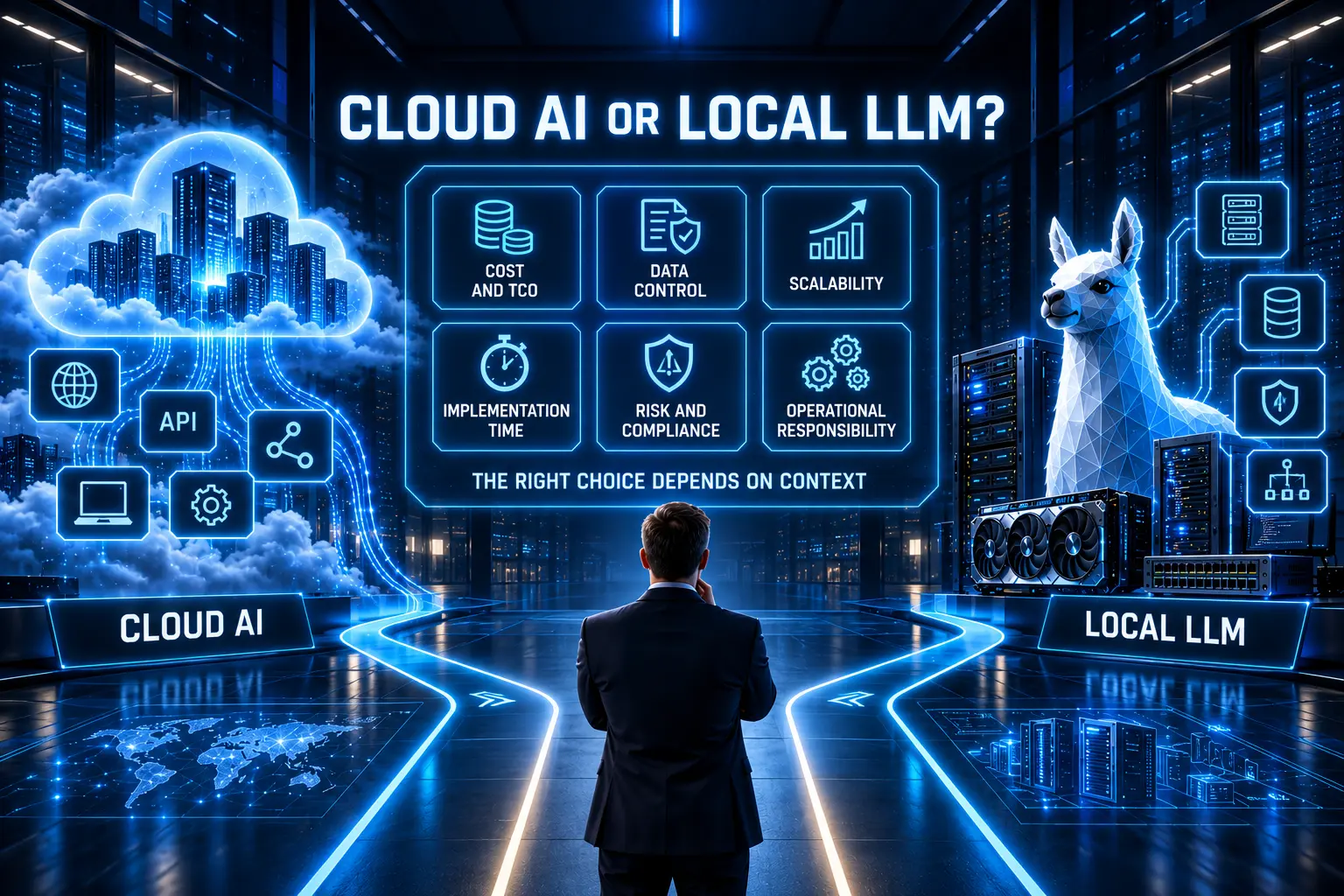
When is cloud appropriate, and when is an on-premises solution appropriate?
Cloud can make it easier to get started, scale and access ready-made services. In a business context, however, assessment is needed of where data is processed, who can access it, the legal basis for processing and who is accountable for the use of model outputs.
Automating part of a task does not remove all responsibilities. Solution maintenance, output verification and handling exceptional situations remain necessary. Only an assessment of the entire process can establish whether the technology delivers value to the organization and the people working in it.
The objective first, followed by requirements and priorities
Where an LLM runs does not by itself determine cost, privacy or response quality. Cloud and local solutions can be beneficial under different conditions. The starting point is a specific business task: which area needs improvement, what information is needed, and which criteria will confirm the value of the solution?
- Definition of the objective and a measure of the outcome. Examples include reducing the time needed to search procedures, prepare a document or analyze information while maintaining the required accuracy.
- Definition of mandatory conditions. The conditions cover permitted data processing, minimum response quality and required availability. An option that fails these conditions needs changes or exclusion from the comparison.
- Definition of priorities among eligible options. The comparison covers the cost of completing the task, information protection, quality, turnaround time and maintenance requirements.
- Verification of assumptions in a pilot. The pilot is based on representative tasks and data approved for testing. The results and limitations provide material for assessment by the person authorized to make the decision.
For multiple criteria, a weighted average can be used: scores receive weights reflecting each criterion's importance to the objective. Criteria need clearly defined scales, with higher scores always indicating better outcomes. The weights require justification and an assessment of whether small changes reverse the comparison result. If they do, the choice requires particularly careful assessment. A weight does not replace a mandatory condition: a low price cannot offset impermissible data processing or inadequate quality.
Preference should be given to the required outcome, such as control over access to know-how or the ability to work without an external connection. Being “local” is not itself a measure of how effectively these controls work.
| Example objective | What may matter most | What to check in practice |
|---|---|---|
| Working with confidential technical documentation | Protecting know-how and ensuring responses agree with sources | Who has access, where data goes and whether responses accurately reflect the documentation |
| Preparing drafts of public content | Staff time, cost and ease of editing | How long it takes to obtain accurate material after review and corrections |
| Finding information in procedures | Accuracy, currency and verifiable sources | Whether the model uses the correct procedure version and whether the response can be confirmed |
| Supporting work during a connectivity outage | Availability and independence from an external connection | Whether the entire required solution works without connectivity, not just the model |
These are examples of priorities, not ready-made architecture recommendations. A higher local deployment cost may be justified if it meets important requirements for protecting know-how. The value of the information and the consequences of disclosure also matter. The effectiveness of access and data flow controls still needs verification. Owning a server does not automatically guarantee it.
Know-how includes documentation and human expertise
Technical knowledge is an important source of organizational value and competitive advantage. Its protection covers both documentation and employee experience. Not everything has been recorded in procedures, and not everyone knows all the information contained in the documentation. These two forms of knowledge complement each other.
An LLM can help find and organize information, but it does not automatically have access to the experience of a person familiar with the process, its limitations and exceptional situations. An explanation provided to the model by an employee may itself contain valuable know-how. Protection rules should therefore cover both uploaded documents and the content of questions, additional explanations and conversations.
The human role extends beyond checking responses. It includes providing context, assessing relevance and applying information to a real task. Deployment benefits should also reach the people doing the work, for example through easier access to knowledge and fewer repetitive tasks. Assessment also covers the time needed to operate the tool, correct outputs and resolve problems.
Cost, privacy and quality require joint assessment
Cost of a useful outcome: alongside infrastructure or subscription charges, the calculation should include the time people spend checking responses, making corrections and repeating queries. A cheaper response may require more work, while a more expensive service does not necessarily produce an outcome worth the additional cost. The comparison should cover the same task scope and required quality level.
Privacy and information protection: for both options, assessment is needed of who can access data, what is recorded in conversation histories, logs and backups, how long it remains available and whether integrations send it elsewhere. Personal data privacy and know-how confidentiality are related but distinct needs: a technical document may be valuable even without personal data. Service terms, configuration and daily operations matter alongside server location.
Response quality: specific solutions should be assessed using the same representative tasks and materials. The assessment covers accuracy, completeness, agreement with sources and the extent of corrections needed. Deployment location does not replace this test: the model, available and current information, the wording of the question and task context all matter. Fluent language is not evidence that a response is true.
These aspects interact. Limiting shared data may protect information but also deprive the model of necessary context. Savings on a service may increase verification time. Broader access to information does not guarantee an accurate response either and needs justification by the task scope. A pilot should assess the entire process, including human work, rather than the model response alone.
What should an enterprise comparison cover?
The comparison should go beyond the price of a single query. It should cover total cost of ownership, the level of control, scalability and operational requirements.
| Criterion | Cloud | On-premises model |
|---|---|---|
| Getting started | A quick start may be possible without purchasing servers. Integration and service assessment still take time | Investment and environment preparation |
| Data | With the provider, subject to the agreement and configuration | In an environment controlled by the organization |
| TCO | Service fees, integrations and support. Dependent on the agreement and usage | Hardware purchase or rental, maintenance, energy and staff time |
| Scaling | Easier, depending on the service | Requires hardware and redundancy planning |
| Accountability | Shared with the provider, but not eliminated | More extensively borne by the organization |
| Privacy and confidentiality | Assessment of service terms, access, retention and data flows | Assessment of access, logs, backups and integrations within the organization’s environment |
| Quality and human work | Tests on business tasks and time spent reviewing and correcting responses | The same quality criteria and time spent reviewing and correcting responses |
Both options require a defined scope of use, security requirements and an authorized person to approve deployment and accept risk within their delegated authority. A practical list of requirements appears later in the article.
Terms used in this article
- LLM - large language model, AI - artificial intelligence. Inference means using a model to generate a response.
- GRC - governance, risk management and compliance, including accountability and oversight, compliance means meeting applicable requirements.
- TCO - total cost of ownership over a defined period, CapEx - capital expenditure, OpEx - operating expenditure.
- On-premises - deployment in the organization's own environment. Cloud may mean rented infrastructure, a ready-made application (SaaS) or access to a model through an application programming interface (API). These services differ in their allocation of responsibilities and billing models.
- DPA - a personal data processing agreement, where such a relationship exists, SLA - an agreed service level, DPIA - a data protection impact assessment, where required.
- GDPR addresses personal data protection. ISO/IEC 27001 sets requirements for an information security management system. TISAX is a mechanism for assessing and exchanging information security assessment results in the automotive industry. These are not interchangeable forms of compliance evidence.
- MFA - multi-factor authentication, GPU - graphics processing unit used for computation, IP - intellectual property. A token is a unit of text processed by a model, not necessarily a whole word.
- Data sovereignty here means the ability to control the location, rules and access associated with processing. It requires appropriate configuration, agreements and oversight. Server location alone does not guarantee it.
Cost break-even point - a scenario model
Role of the calculator: the model below shows only how infrastructure costs depend on utilization. It does not assess know-how protection, response quality or business value. It can be one input when comparing options that meet mandatory conditions.
A key factor is infrastructure utilization. The model below calculates a simplified infrastructure cost based on average daily hours of active GPU use. This does not mean hardware uptime around the clock, but the actual time during which infrastructure serves LLM tasks.
Model assumptions: the calculator values illustrate the relationship between infrastructure cost and utilization. They are not universal market prices. Actual TCO depends on factors including GPU class, solution architecture, energy and cooling costs, maintenance and cloud billing arrangements.
Calculation scope: local cost = CapEx + daily usage hours × local hourly rate × number of days. Cloud cost = daily usage hours × cloud hourly rate × number of days. The model uses 365 days per year. The comparison assumes equivalent infrastructure performance, response quality and availability requirements. A GPU hour is not automatically equivalent to the cost of a SaaS application or a token-billed API.
The model does not separately account for fixed staff and service costs, idle power consumption, redundancy, hardware replacement, licensing, migration or the cost of capital. It does not discount expenditure and excludes the hardware's residual value. An investment decision requires a full TCO for both options, based on workload measurements and quotations.
Scenario parameters
Infrastructure cost by utilization
Linear modelInterpreting the result
Break-even is the average daily usage at which both options have equal costs over the selected period. Above this threshold, the model indicates a lower local cost. No intersection within 0-24 hours means the local option does not gain a cost advantage within that range under the selected parameters. The result applies only to the stated infrastructure assumptions.
This approach to TCO analysis is inspired by comparisons of local and cloud infrastructure, including: Lenovo Press - On-Premise vs Cloud Generative AI Total Cost of Ownership 2026 Edition . This is a publication by an infrastructure manufacturer, based on specific configurations and assumptions. This calculator does not reproduce its full methodology.
Preliminary assessment of deployment conditions
Help with choosing an LLM deployment model
Four questions support a preliminary assessment of deployment conditions once the objective and mandatory requirements are defined. The form indicates a direction for further analysis. It does not measure risk, response quality or the value of know-how and does not replace a full cost and risk assessment or a DPIA where required.
Rules: a prohibition on external processing excludes cloud for the affected data. Missing operational resources must be provided before local deployment. Where both options are permitted, cost preferences and control needs are compared. Permission to use cloud does not give it an advantage. No scores or weights are used.
What to verify before deciding
A hybrid architecture combines local and cloud processing for different tasks or data classes. It requires defining what may leave the organization's environment and controlling data flows. A prohibition on external processing cannot be bypassed simply by calling a solution hybrid.
Business objective, GRC and security requirements
Key requirements for both deployment models. Provider-related requirements apply according to the scope of the service:
- Approved AI services: the organization should define which tools are permitted for corporate data. Internal policy may exclude unapproved or free services if they do not meet the adopted security, privacy and supplier management requirements.
- Contractual terms and privacy: the assessment should cover the service terms, rules for using prompts and input data, retention and provider access, with an appropriate data processing agreement (DPA) required where applicable.
- Rules for employees: clear rules for allowing customer data, source code or financial information, depending on data classification and the approved use case. These categories do not automatically imply a prohibition in every service.
- Location and transfer controls: processing and storage locations need to be identified, and any data transfers assessed against organizational requirements and applicable regulations.
- Secure access: MFA for user accounts, limited permissions and protection of API keys and service accounts. Programmatic access requires different mechanisms from interactive login.
- Business continuity and exit planning: planning covers how work continues during an outage and how data is recovered, with separate arrangements for migration or service termination. An exit plan does not replace a contingency plan.
- Maintenance and migration: assessment of dependencies on hardware, libraries, licenses and models, and of the cost of changing solutions. Auditability requires event logs, retention and protected access to records.
This is a practical checklist, not a complete interpretation of legal requirements. The controls should be tailored to the data class, process, provider, architecture and risk assessment results.
Conclusions
The most suitable option achieves the business objective at an acceptable cost, risk and quality level. Mandatory conditions are assessed first, followed by priorities and pilot results. Neither cloud nor owned infrastructure alone guarantees savings, privacy or accurate responses.
The final assessment and implementation decision belong to the person accountable for the process, considering task specifics and acceptable risk levels.
The calculator and form support preliminary exploration only. Deployment is justified by an assessment of the entire process, knowledge protection and benefits for the organization and the people working in it.
Sources and documentation
- NIST AI Risk Management Framework 1.0 - a framework for managing risk throughout the AI system lifecycle.
- Regulation (EU) 2024/1689 - AI Act - the official text of EU legislation on AI systems and models.
- ISO/IEC 42001:2023 - requirements for an artificial intelligence management system.
Questions and answers: LLM in business
Is a local LLM always cheaper than cloud?
No. The local option has upfront and maintenance costs. It may gain an advantage only at a suitable level of utilization and over a suitable time horizon. TCO calculation is therefore more informative than comparison of the price of a single query alone.
When can a local LLM reach break-even?
Break-even occurs when the cumulative costs of both options are equal. Only beyond that threshold may the local option become cheaper under this model's assumptions. This depends primarily on CapEx, hourly costs, utilization and the analysis horizon.
Does local AI automatically mean greater security?
No. Local deployment can increase control over processing location, but places responsibility for access, updates, backups, logs, business continuity, infrastructure protection and output quality on the organization.
Can cloud AI be used for corporate data?
Yes, but not through automatic approval. The specific service, provider, processing terms, data location, configuration, access controls and requirements arising from the process and information classification require assessment.
Is banning free AI tools a GDPR or ISO 27001 requirement?
Not as a universal requirement. An organization may establish such a ban in its policy if justified by risk assessment or requirements concerning data and providers. The label "free version" alone does not determine compliance.
What role does GRC play in LLM deployment?
GRC translates an AI use case into requirements for processes, data, risk, providers, accountability, controls and evidence of operation. This keeps technology decisions connected to the organization's needs.
Can AI independently make decisions on behalf of employees?
For applications with a significant impact on security, compliance or a business process, the scope of autonomy and accountability must be clearly defined. In many cases, a model's output should remain a proposal subject to review and approval by an authorized person.