


SIEM in Practice: The Gap Between Monitoring and NIS2 Requirements
This case study documents the practical implementation of Wazuh SIEM in a Proxmox test environment. The goal was to bridge GRC theory with operational reality - to check what SIEM really delivers in terms of monitoring, vulnerability detection, and practical risk data.
Why This Project Matters (Practical Perspective)
In GRC, it is easy to meet formal requirements: policies, procedures, audit records.
It is much harder to build real incident detection capability.
This project was created to verify in practice:
- whether monitoring actually enables incident identification,
- which data has real value for risk analysis,
- where compliance ends and operational security begins.
SIEM in the Context of NIS2 and UKSC - Where Is the Real Gap?
The NIS2 directive and national regulations require not only the implementation of security policies, but real capability to:
- detect incidents,
- respond,
- report events.
In practice, sector reports regularly show that there is still a gap between meeting formal requirements and operational readiness. Most often, this concerns areas such as:
- central log analysis,
- event correlation,
- real-time incident visibility.
In this context, SIEM ceases to be just a technical tool - it becomes a component of building real operational capability.
Technical Details: Proxmox and Implementation Reality
Wazuh was implemented as a virtual machine in a Proxmox environment. Right from the start, a challenge appeared that teaches humility towards technology.
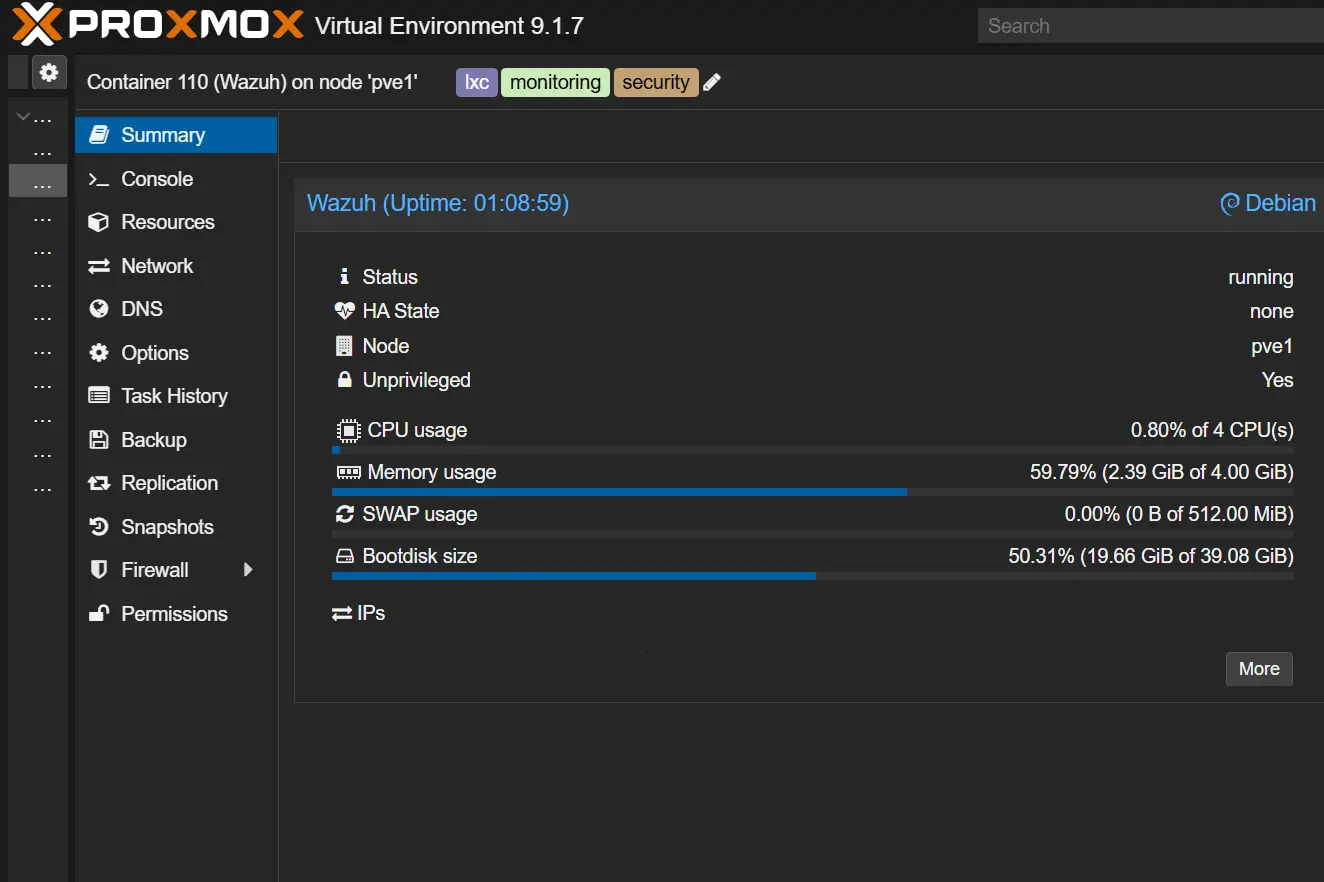
Implementation details: Wazuh as a VM in Proxmox.
Minimum Requirements Adopted in This Test Environment
This implementation used a starting configuration based on the resources visible in the environment screenshot. It is a practical reference point for a test environment, not a universal minimum for every production deployment.
- CPU: 4 vCPU
- RAM: 4 GiB
- Disk: approx. 40 GiB (39.08 GiB)
- SWAP: 512 MiB
- System: Debian (container/VM in Proxmox)
Wazuh is delivered in OVA format, which is not natively supported by Proxmox. This required manual disk conversion and CLI (Command Line Interface) import. This perfectly illustrates the difference between a "theoretical" and a real implementation - there is no "Next" button here, only architecture understanding.
The monitored environment included:
- 2 x Windows (different versions)
- 1 x Linux (Debian VM as a service server)
Network segmentation (VLAN) was applied to separate monitored traffic. This required configuring appropriate firewall rules - agents must have access to the server, but without opening unnecessary "doors" in the network.
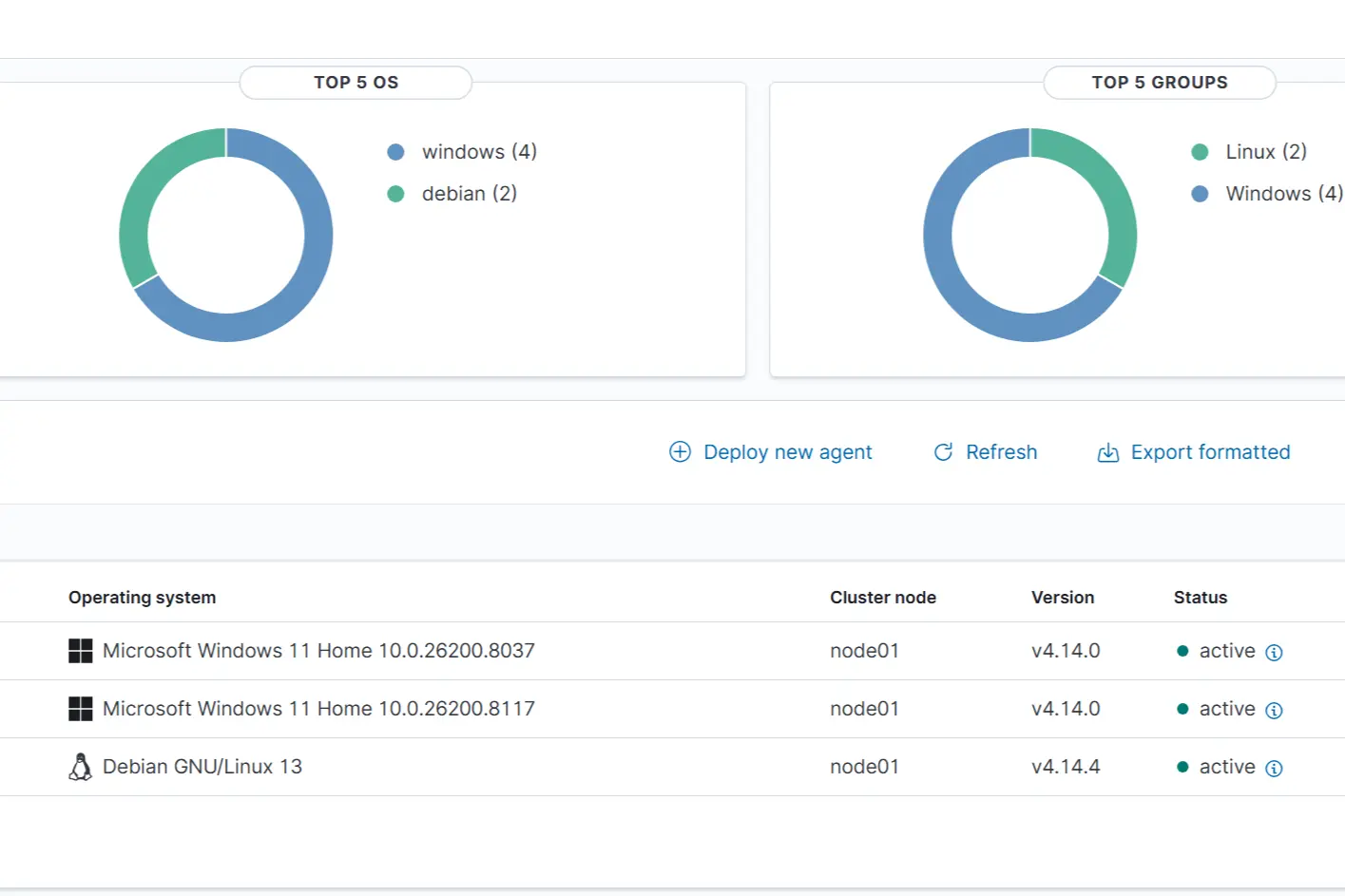
Endpoint visibility - the foundation of asset control.
What Did the System Actually Show?
- Vulnerabilities: Even in a small, controlled environment, the system revealed many vulnerabilities, including high and critical ones.
- Updates: It was confirmed that a "fully updated system" is a myth. Some vulnerabilities result from dependencies, libraries, and configurations not always covered by the standard system update process.
- Visibility: It is clear which assets maintain reporting continuity and which require intervention to restore full observability (agent status).
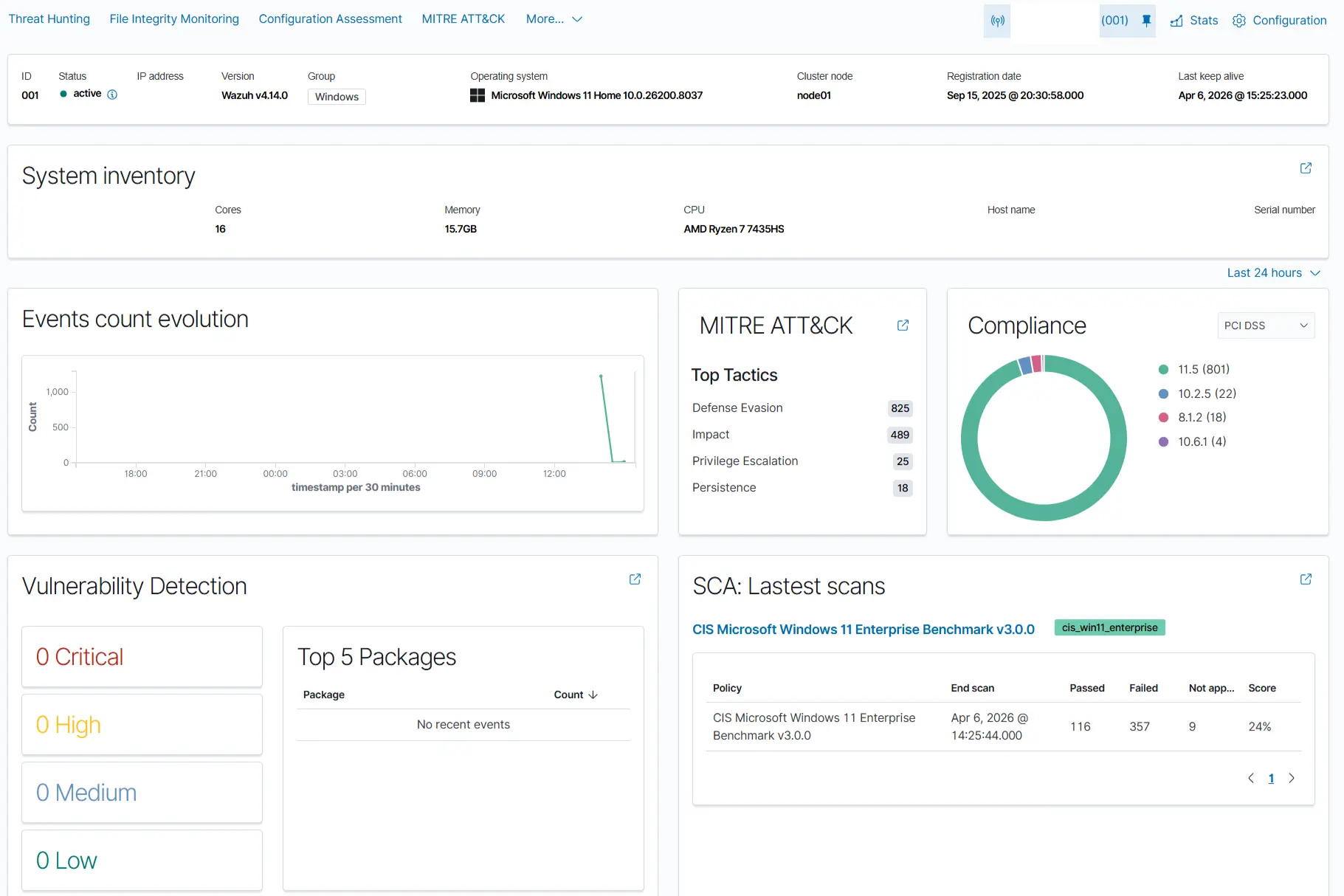
Actual vulnerability exposure - this is where risk analysis begins.
Reality Check: Why Logs Alone Are Not Security
- logs ≠ security
- monitoring ≠ detection
- detection ≠ response
- response ≠ risk management
Only the combination of these elements provides real value.
ISO/IEC 27001 and ISO/IEC 27002 Perspective - Practical Implications
Thanks to this project, controls from the new version of the standard became more than just numbers:
- ISO/IEC 27001:2022: defines ISMS system requirements and organizational responsibility for the effectiveness of safeguards.
- ISO/IEC 27002:2022: clarifies implementation practices and how to implement and maintain controls.
- 8.15 (Logging): Excess data is noise. Selection is key - what we log to be able to reconstruct an incident without filling up disks.
- 8.16 (Monitoring activities): Without business context, monitoring is just blinking indicators. You need to know what is "normal."
- 8.8 (Management of technical vulnerabilities): Real SIEM visibility drastically shortens time-to-remediate.
The most important conclusion: monitoring is not about collecting data, but about making decisions based on risk context and response capability.
Auditor's "Aha!": Vulnerability Management
Experience from the project allowed audit questions to be refined so that they assess process effectiveness, not just the presence of a tool.
- Prioritization criteria: What formal criteria (CVSS, business context, asset exposure) determine the order of actions and where are they approved?
- Evidence of effectiveness: What metrics confirm process effectiveness (e.g., SLA adherence, exposure reduction trend, percentage of closed actions)?
- Exception management: What is the procedure when a vulnerability cannot be remediated within the required timeframe: who accepts the risk and what temporary safeguards are implemented?
- Closure and oversight: What does formal vulnerability closure look like and who approves it?
File Integrity Monitoring (FIM)
I tested monitoring of configuration file changes (e.g., in the `/etc/` folder on Linux and key branches of the Windows Registry).
The conclusion? The tool works brutally effectively - it will detect every change, but if you do not define what and why you are monitoring, you will drown in alerts after every system update.
My Test Environment vs. Reality
| Aspect | Test environment | Organization (Enterprise) |
|---|---|---|
| Goal | Understanding technology and implementation details. | Risk management and business continuity. |
| Scale | Small (selected operating systems and VMs). | Large (complex infrastructure, various operating systems, including OT and cloud). |
| Compliance | In a small-scale test environment, it may be disproportionate to risk, but remains valuable for learning. | In organizations, it is about meeting key controls from the Statement of Applicability and actively eliminating vulnerabilities. |
| Response | Optional You can break things to learn. |
Critical Business continuity, risk owner responsibility, and compliance. |
Summary
Implementing SIEM, even in a test environment, shows one key thing:
the difference between declared and actual security level.
In practice, it is not about whether the system exists, but:
whether the organization can detect events, interpret them, and take appropriate action.
This is the area that most often reveals the biggest gap between compliance and operational reality.
In practice, it is worth asking one question:
do we see incidents, or are we just collecting data?
Recommendations (Based on Recognized Practices)
- Link SIEM to risk: every critical rule and alert should have an assigned risk owner and a defined response time (ISO/IEC 27001:2022, NIST CSF 2.0).
- Establish a minimum set of security KPIs: mean time to detect (MTTD), mean time to respond (MTTR), percentage of critical vulnerabilities closed within SLA, and month-to-month exposure trend.
- Periodic control effectiveness reviews: quarterly review of logging quality, detection rules, and false positives (ISO/IEC 27002:2022).
- Process-based vulnerability management: identification, analysis, prioritization, remediation or mitigation, verification, and formal closure - in line with NIST SP 800-40r4 and ISO/IEC 27002:2022 control 8.8.
- Build organizational resilience, not just compliance: combine monitoring with risk management, business continuity planning, and periodic control effectiveness reviews, according to current NIST and ENISA guidance.
Sources and documentation
- Wazuh - User manual - official documentation for the server, agents, indexer, alerts, and event management.
- Proxmox VE - documentation - documentation for the virtualization platform used to run the test environment.
- NIST Cybersecurity Framework 2.0 - a reference for the Detect, Respond, and Recover functions.
Q&A: SIEM
What is SIEM?
SIEM (Security Information and Event Management) is a system that collects, correlates, and analyzes security logs from across an organization's infrastructure in real time. It combines two functions: SIM (Security Information Management) for log storage and compliance reporting, and SEM (Security Event Management) for real-time monitoring, alerts, and incident detection. SIEM enables security teams to identify threats, investigate incidents, and demonstrate compliance with standards such as ISO/IEC 27001.
What is a vulnerability?
A vulnerability is a weakness in a system, application, configuration, or process that can be exploited to compromise confidentiality, integrity, or availability. The mere presence of a vulnerability does not mean an incident, but it increases risk exposure.
What is the difference between ISO/IEC 27001 and ISO/IEC 27002?
ISO/IEC 27001 defines requirements for an Information Security Management System (ISMS) and is certifiable. ISO/IEC 27002 is a best-practice guide explaining how to implement and maintain security controls.
What is NIS2?
NIS2 is a European Union directive aimed at raising the level of cybersecurity in key and digital sectors. It requires organizations to implement technical and organizational measures, including the ability to detect, respond to, and report incidents. Learn more at gov.pl
What is the S46 System?
The S46 System is a national system for reporting ICT security incidents, required by Polish law for key and critical entities. More information at gov.pl
What is UKSC?
UKSC (Act on the National Cybersecurity System) is a Polish law regulating cybersecurity obligations, including the implementation of technical and organizational measures and incident reporting. Details at gov.pl
What does VM mean in a security context?
VM most often means Vulnerability Management, a continuous process including identification, assessment, prioritization, mitigation, and verification.
What does VM mean in a virtualization context?
In infrastructure, VM means Virtual Machine, an isolated environment running on a hypervisor. Each VM acts as an independent operating system with its own logical resources (CPU, RAM, disk, network), which facilitates segmentation, testing, and secure deployments.
How are vulnerabilities classified?
The simplest division is descriptive classes: Low, Medium, High, Critical. CVSS (Common Vulnerability Scoring System) is also often used, rating vulnerabilities in software and hardware from 0.0 to 10.0. In practice, mature organizations combine technical scoring (CVSS) with business context, asset exposure, exploit availability, and required remediation deadlines (SLA).