


The human “role”
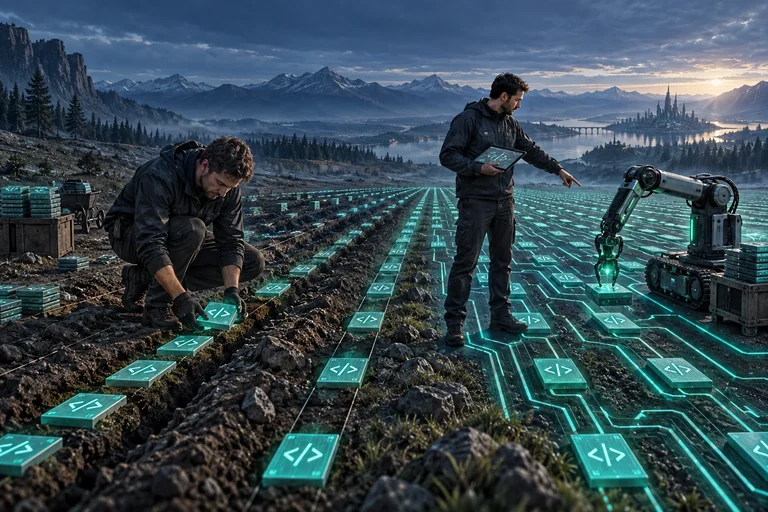
Imagine a field that needs to be prepared for planting. The work is hard and slow, and someone's livelihood depends on the result. Then a machine becomes available that can take over much of the effort.
Does human work lose its value? Or does the source of that value change?
From hard work to thoughtful use of tools
The image of immense human effort in Władysław Reymont's short story Orka (Ploughing) has stayed with me. I am not comparing the characters' experiences with working at a computer. But that literary image makes me reflect on how much changes when a tool can ease someone's workload.
Work deserves respect even when it is repetitive and done by hand. Making it easier does not diminish its importance. We do not need to preserve the old level of difficulty for the result to remain valuable.
A tool can reduce the effort needed to perform a task. It does not guarantee that we have chosen the right task.
Using AI takes practice
While building my website, I repeatedly received suggestions that did not match what I wanted to achieve. A text did not express my meaning. An image did not fit the intended style. A solution worked in one place but did not fit the rest of the site.
Further instructions, clarification and revisions were needed, sometimes followed by manual changes. The final result took shape gradually.
Some difficulties may have come from how I described my expectations. Writing an instruction takes work too. You need to organise an idea, identify constraints and explain what matters. Sometimes I could only define what I needed more precisely after seeing the first version.
Knowing my own limitations matters as well. If I do not understand a proposed solution, it is harder to judge whether it is correct. I then need additional knowledge, a test or advice. A convincing explanation from the tool is not enough.
Less repetition, more attention to the whole
One useful application of AI for me was improving pages and making them consistent. A change accepted in one place often needed to be applied elsewhere. Repeating similar tasks took time, even when the direction was already clear.
AI helped shorten that stage. It also made it easier to produce a version of an idea that I could see and test.
This did not mean I stopped thinking about the project. I could give more attention to the whole: appearance, style, information structure, navigation and usability. I considered whether an element was needed, whether it fitted the others and whether it actually helped the reader.
Generated results need to be checked
For text, I ask whether it expresses my meaning, is understandable and avoids claims I cannot support. For a website, I check whether a change works in different places and whether it makes other elements harder to use.
Errors can occur in an AI suggestion, but also in my assumptions or revisions. Review should therefore involve more than finding the tool's mistakes. I also need to question my own decisions.
For me, human oversight matters when it can influence the outcome. Simply clicking "accept" is not enough. It must be possible to reject a proposal, change direction and stop publication if doubts arise.
The greater the consequences of using a result, the more carefully its verification should be defined. A draft illustration requires a different level of review from a solution that affects data, security or a working process.
A faster first draft is not the end of the work
I do not always feel that AI gives me more free time. Preparing a first version may take less time, but revisions, tests and optimisation follow.
Sometimes the ease of trying another version leads to further refinement. Time saved at one stage is spent at another. That need not be a problem if it makes the result more useful, but the effort should be acknowledged.
I would therefore not judge its value solely by the number of generated outputs or the speed of a response. What matters is how much work is needed to make the result correct, useful and maintainable.
People still contribute experience and direction
To the statement "AI did that", I would reply: the tool contributed to the implementation. My contribution included the idea, direction, selection of proposals, revisions and verification of the result.
For businesses, this means involving specialists in the selection and introduction of tools. People who know a process can identify its exceptions, constraints and the consequences of errors. Their knowledge helps establish what is worth automating and how to assess the result.
Concerns about change remain understandable. Implementation should therefore include time to learn, clear rules and support. Access to technology alone does not provide the conditions for using it well.
Transformation requires careful judgement
I do not treat my experience as evidence that every job will remain unchanged. Technology can significantly alter tasks and the organisation of work. But taking over some activities should be distinguished from replacing a person's entire contribution.
Technology changes, and so does the human role. A change in that role does not in itself mean that people have been replaced.
Systems support people - people create value.
Sources and documentation
- Władysław Stanisław Reymont - “Orka” (Ploughing) - Polish text at Wolne Lektury.